Performance of okra cultivation in intercropping with green manures
DOI:
https://doi.org/10.18378/rvads.v21i1.11316Keywords:
Abelmoschus esculentus, Cajanus cajan, Crotalaria spectabillis, IntercroppingAbstract
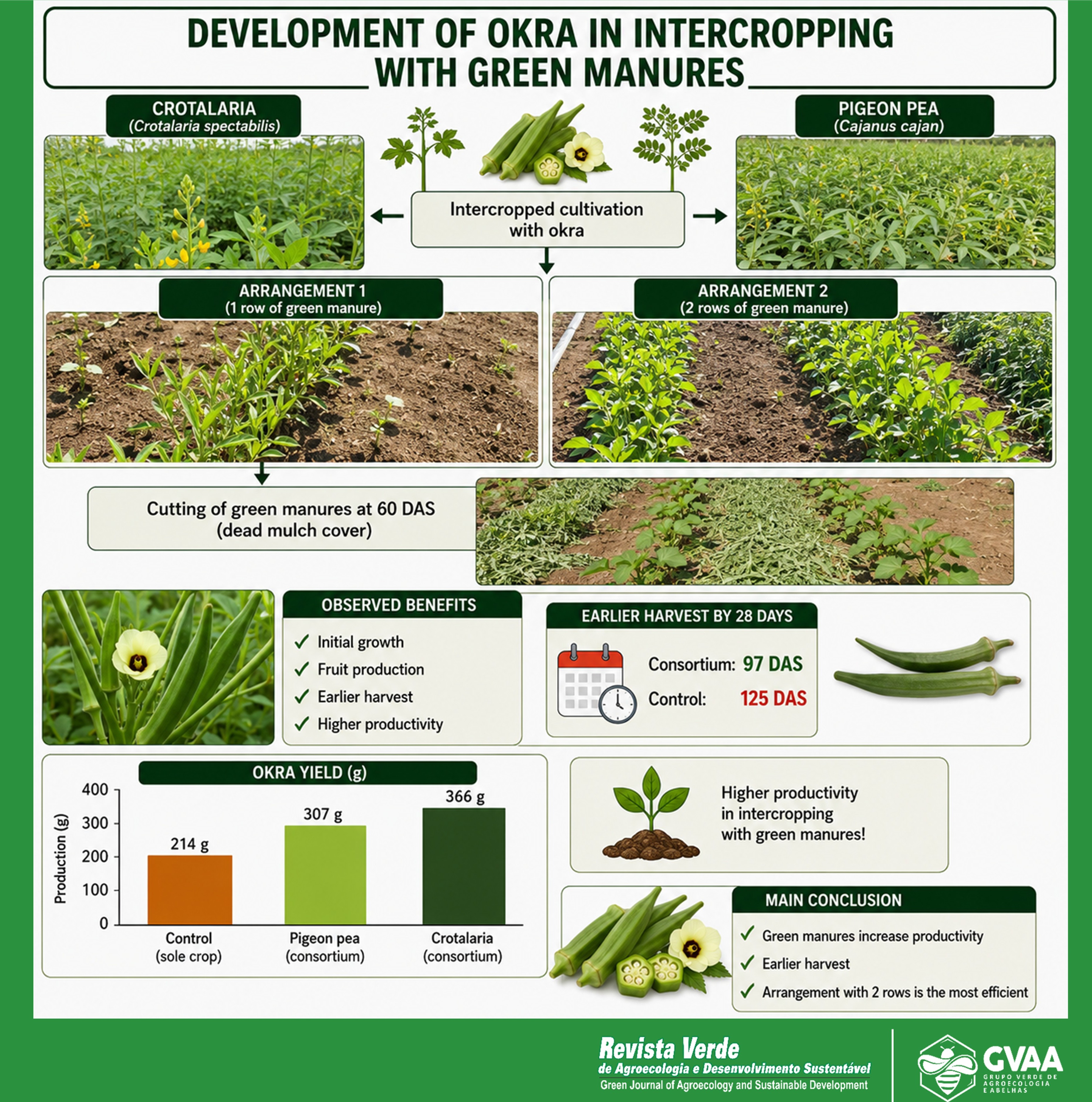
Green manure is the practice of cultivating leguminous plants or grasses with the aim of improving the productive conditions of the soil, and considering the socioeconomic relevance of okra for small farmers, this technique may be promising in okra cultivation. Thus, the objective of this study was to investigate the use of green manure intercropped with okra, evaluating two plant arrangements with two plants used as green manure. The experiment was conducted in randomized blocks, with three replications, in a 3 × 2 factorial arrangement, where pigeon pea and sunn hemp were evaluated as green manure and control (without intercropping), along with two arrangements of green manure in the interrows of the okra crop, consisting of one line of green manure (Arrangement 1) and two lines of green manure (Arrangement 2). The results demonstrated that the use of green manure, in addition to increasing okra production (g), also promoted an earlier onset of okra fruit production by 28 days, beginning at 97 DAS, whereas in the control treatment it started only after 125 DAS. The plant arrangement also showed an effect, indicating a higher growth rate and production of okra plants developed under the arrangement with two lines of green manure. Therefore, intercropping with sunn hemp and pigeon pea as green manure proved efficient for okra cultivation.
Downloads
References
ABRANCHES, M. O.; SILVA, G. A. M.; SANTOS, L. C.; PEREIRA, L. F.; FREITAS, G. B.; Contribuição da adubação verde nas características químicas, físicas e biológicas do solo e sua influência na nutrição de hortaliças. Research, Society and Development, v. 10, n. 7, 1-17p., 2021. 10.33448/rsd-v10i7.16351 DOI: https://doi.org/10.33448/rsd-v10i7.16351
CARDOSO, J. M. S.; PEREIRA, Y. S.; SOUSA, Y. S. B.; RESENDE, F. V.; VIDAL, M. C. Desempenho agronômico do tomateiro após adubação verde em sistema em transição agroecológica. Cadernos de Agroecologia, v. 15, n. 2, 1-6p 2020.
CHERUBIN, M. R. Guia prático de plantas de cobertura: aspectos fitotécnicos e impactos sobre a saúde do solo. Piracicaba: ESALQ-USP, 2022. 126p. DOI: https://doi.org/10.11606/9786589722151
FARIA, L. N.; BOMFIM-SILVA, E. M.; PIETRO-SOUZA, W.; VILARINHO, M. K. C.; SILVA, T. J. A.; GUIMARÃES, S. L. Características morfológicas e produtivas de feijão guandu anão cultivado em solo compactado. Revista Brasileira de Engenharia Agrícola e Ambiental, v. 17, n. 5, 2013. 497-503p. 10.1590/S1415-43662013000500005 DOI: https://doi.org/10.1590/S1415-43662013000500005
FERREIRA, D. F. SISVAR: A computer analysis system to fixed effects split plot type designs. Revista brasileira de biometria, v. 37, n. 4, p. 529-535, 2019. 10.28951/rbb.v37i4.450 DOI: https://doi.org/10.28951/rbb.v37i4.450
GUERRA, J. G. M.; ESPINDOLA, J. A. A.; ARAÚJO, E. S.; LEAL, M. A. A.; ABBOUD, A. C. S.; ALMEIDA, D. L.; POLLI, H.; NEVES, M. C. P. RIBEIRO, R. L. D. Adubação verde no cultivo de hortaliças. In: WILDNER, L. P.; MORALES, R. G. F.; JUSTEN, J. G. K.; KRUNVALD, L. Plantas para adubação verde e cobertura do solo: Caracterização das espécies e informações para cultivo no estado de Santa Catarina. Florianópolis: Epagri, p. 266-290, 2023.
KOPPEN, W.; GEIGER, R. (eds). Handbuck der Klimatologie. Berlin, 1961. 420p.
LIMA, C. E. P.; MADEIRA, N. R. Sistema de Plantio Direto de hortaliças (SPDH). 2013. Disponível em: <https://www.infoteca.cnptia.embrapa.br/infoteca/bitstream/doc/975518/1/HortalicasRevista9.pdf>. Acesso em junho de 2024.
LIMA FILHO, O, F.; AMBROSANO, E, J.; WUTKE, E, B.; ROSSI, F.; CARLOS, J, A, D. Adubação verde e plantas de cobertura no Brasil: fundamentos e prática. 2 ed. Brasília, Embrapa, 2023. 586 p.
MARTINS, C. A. S.; LOPES, J. C.; MACEDO, C. M. P. Tratamentos pré-germinativos em sementes de quiabo em diferentes estádios de maturação do fruto. Semina: Ciências Agrárias, v. 32, n. 4, p. 1759-1770, 2011. 10.5433/1679-0359.2011v32Suplpl759 DOI: https://doi.org/10.5433/1679-0359.2011v32Suplp1759
MOTA, W. F.; FINGER, F. L.; SILVA, D. J. H.; CORRÊA, P. C.; FIRME, L. P.; RIBEIRO, R. A. Composição mineral de frutos de quatro cultivares de quiabeiro. Editora UFLA, v. 32, n. 3, p. 762-767, 2008. DOI: https://doi.org/10.1590/S1413-70542008000300009
OLIVEIRA, M. W. Adubação verde com Crotalaria juncea em áreas de implantação ou reforma de canaviais, em pequenas propriedades rurais. In: OLIVEIRA, R. J. Extensão Rural: práticas e pesquisas para o fortalecimento da agricultura familiar. 3 ed, p. 45-66, 2021. DOI: https://doi.org/10.37885/201102246
SOUSA, D. M. G.; LOBATO, E. Cerrado: correção do solo e adubação. Brasília, DF: Embrapa Informação Tecnológica; Planaltina, DF: Embrapa Cerrados, 2004. 410p.
TIVELLI, S. W.; KANO, C.; PURQUERIO, L. F. V.; WUTKE, E. B.; ISHIMURA, I.; Desempenho do quiabeiro consorciado com adubos verdes ereto de porte baixo em dois sistemas de cultivo. Horticultura Brasileira, v. 31, n. 3, 2013.
VIEIRA FILHO, J. S. M.; GUERRA, J. G. M.; GOULART, J. M.; ARAÚJO, E. S.; ESPINDOLA, J. A. A.; ROUWS, J. R. C. Management of green manure and organic fertilization with fermented compost fertilizer in agroecological cultivation of American broccoli. Horticultura Brasileira, v. 41, 2023. 10.1590/s0102-0536-2023-e2599 DOI: https://doi.org/10.1590/s0102-0536-2023-e2599
WESTERING, M. R. V.; BORSZOWSKEI, P. R.; CARVALHO, F. C. de. Influência da adubação verde nos componentes de produtividade da cultura do milho. Revista Scientia Rural, v. 1, n. 2, 2021.
WILDNER, L. P.; MORALES, R. G. F.; JUSTEN, J. G. K.; KRUNVALD, L. Plantas para adubação verde e cobertura do solo: Caracterização das espécies e informações para cultivo okno estado de Santa Catarina. Florianópolis: Epagri, 2023, 140p.
Published
How to Cite
Issue
Section
License
Copyright (c) 2026 Maristela Aparecida Dias Guimarães et al.

This work is licensed under a Creative Commons Attribution 4.0 International License.