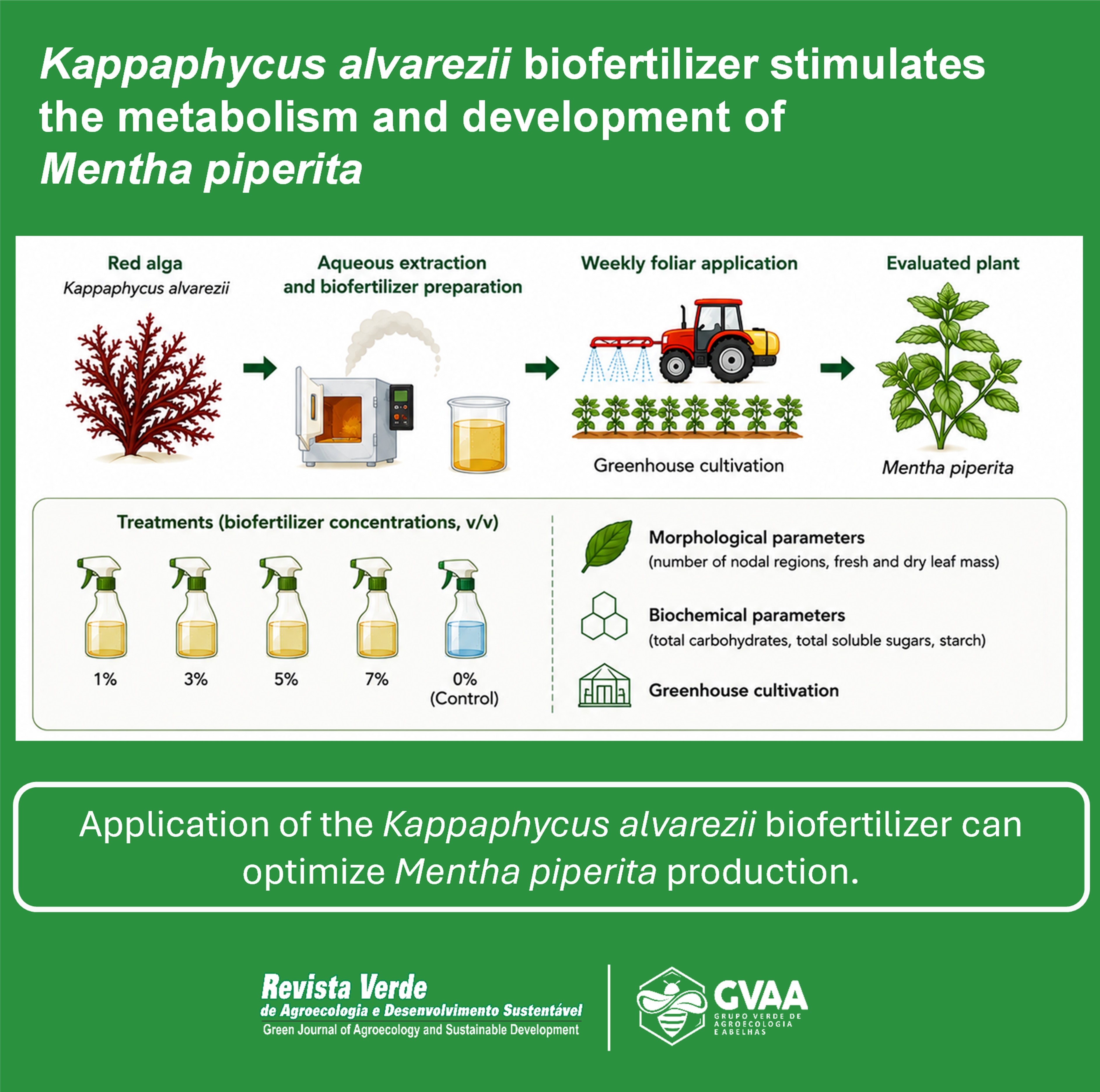
Kappaphycus alvarezii biofertilizer stimulates the metabolism and development of Mentha piperita
DOI:
https://doi.org/10.18378/rvads.v21i1.11315Keywords:
Aqueous extract, Rhodophyta, pippermintAbstract
Mentha piperita, commonly known as peppermint, is a plant valued for its aromatic and medicinal properties, widely used in the food, pharmaceutical, and cosmetic industries. In this sense, the objective of this study was to analyze the morphological and biochemical responses of M. piperita cultivated in a greenhouse, after weekly foliar application of the biofertilizer derived from Kappaphycus alvarezii. The experiment was conducted in a randomized manner, involving 50 plants organized in 25 pots, with two plants per pot and 5 distinct treatments, totaling 10 plants per treatment. Four concentrations of the biofertilizer (1%, 3%, 5%, and 7% - v/v) were investigated, with distilled water as control. The results demonstrate the benefits of the biofertilizer, showing significant increases compared to the control. The application of the biofertilizer at 7% resulted in a 66% increase in the number of nodal regions compared to the control and an elevation of 19.78% in starch content. The concentrations of 3% and 5% increased total carbohydrate levels, with increments of 38.12% and 28.65%, respectively, compared to the control. However, considering the cost-benefit ratio, the application of biofertilizer at 1% proved advantageous, promoting plant development by increasing the fresh and dry mass of leaves, as well as favoring biochemical responses associated with the accumulation of total soluble sugars and starch. Therefore, its use can contribute to optimizing the production of this medicinal and culinary plant.
Downloads
References
AGARWAL, P.; PATEL, K.; DAS, A. K.; GHOSH, A.; AGARWAL, P. K. Insights into the role of seaweed Kappaphycus alvarezii sap towards phytohormone signalling and regulating defence responsive genes in Lycopersicon esculentum. Journal of Applied Phycology, 28(4):2529-2537, 2016. 10.1007/s10811-015-0784-1 DOI: https://doi.org/10.1007/s10811-015-0784-1
AMATO, G.; CARDONE, L.; CICCO, N.; DENORA, M.; PERNIOLA, M.; CASIELLO, D.; DE MARTINO, L.; DE FEO, V.; CANDIDO, V. Morphological traits, yield, antioxidant activity and essential oil composition of oregano as affected by biostimulant foliar applications. Industrial Crops and Products, 222:1-11, 2024. 10.1016/j.indcrop.2024.119702 DOI: https://doi.org/10.1016/j.indcrop.2024.119702
ANYAOKU, I. C.; IGWILO, I. O.; EZEKWESILI, C. N. Phytomedicinal and nutritional values of Mentha piperita. International Journal of Research Publication and Reviews, 4(11):3029-3037, 2023.
BARBOSA, J. C.; MALDONADO JUNIOR, W. AgroEstat. Jaboticabal: FCAV/UNESP, 2015.
BRASIL. Instituto Brasileiro do Meio Ambiente e dos Recursos Naturais Renováveis. Instrução Normativa nº 1, de 21 de janeiro de 2020. Brasília, 2020. Disponível em: https://www.in.gov.br/en/web/dou/-/instrucao-normativa-n-1-de-21-de-janeiro-de-2020-239404226. Acesso em: 07 nov. 2024.
BULGARI, R.; COCETTA, G.; TRIVELLINI, A.; VERNIERI, P.; FERRANTE, A. Biostimulants and crop responses: a review. Biological Agriculture & Horticulture, 31(1):1-17, 2015. 10.1080/01448765.2014.964649 DOI: https://doi.org/10.1080/01448765.2014.964649
DUBOIS, M.; GILLES, K. A.; HAMILTON, J. K.; REBERS, P. A.; SMITH, F. Colorimetric method for determination of sugars and related substances. Analytical Chemistry, 28(3):350–356, 1956. 10.1021/ac60111a017 DOI: https://doi.org/10.1021/ac60111a017
FARVARDIN, M.; TAKI, M.; GORJIAN, S.; SHABANI, E.; SOSA-SAVEDRA, J. C. Assessing the physical and environmental aspects of greenhouse cultivation: a comprehensive review of conventional and hydroponic methods. Sustainability, 16(3):1-34, 2024. 10.3390/su16031273
GHOSH, D.; GHORAI, P.; DEBNATH, S.; INDRAMA, T.; KONDI, V.; TIWARI, O. N. Algal biofertilizer towards green sustainable agriculture. In: SINGH, H. B.; VAISHNAV, A. New and Future Developments in Microbial Biotechnology and Bioengineering. Elsevier Inc., 2022. 10.1016/B978-0-323-85579-2.00019-8 DOI: https://doi.org/10.1016/B978-0-323-85579-2.00019-8
HEDAYATI, S.; TARAHI, M.; BAEGHBALI, V.; TAHSIRI, Z.; HASHEMPUR, M. H. Mint (Mentha spp.) essential oil extraction: from conventional to emerging technologies. Phytochemistry Reviews, 24:3157-3178, 2025. 10.1007/s11101-024-10020-6 DOI: https://doi.org/10.1007/s11101-024-10020-6
HUDZ, N.; KOBYLINSKA, L.; POKAJEWICZ, K.; SEDLÁČKOVÁ V. H.; FEDIN, R.; VOLOSHYN, M.; MYSKIV, I.; BRINDZA, J.; WIECZOREK, P. P.; LIPOK, J. Mentha piperita: Essential oil and extracts, their biological activities, and perspectives on the development of new medicinal and cosmetic products. Molecules, 28(21):1-27, 2023. 10.3390/molecules28217444 DOI: https://doi.org/10.3390/molecules28217444
JAMWAL, S.; KUMARI, A.; VEERAGURUNATHAN, V.; PRASAD, K.; GHOSH, A.; KUMAR, R. Enhancing growth, yield, essential oil content, and composition of holy basil (Ocimum tenuiflorum L.) using red algae-based bio-stimulant under acidic conditions of the Western Himalayas. BMC Plant Biology, 25:1-11, 2025. 10.1186/s12870-025-06064-1
KARTHIKEYAN, K.; SHANMUGAM, M. The effect of potassium-rich biostimulant from seaweed Kappaphycus alvarezii on yield and quality of cane and cane juice of sugarcane var. Co 86032 under plantation and ratoon crops. Journal of Applied Phycology, 29:3245-3252, 2017. 10.1007/s10811-017-1211-6 DOI: https://doi.org/10.1007/s10811-017-1211-6
KUMARI, J.; HAQUE, M. I.; JHA, R. K.; RATHORE, M. S. The red seaweed Kappaphycus alvarezii antiporter gene (KaNa+/H+) confers abiotic stress tolerance in transgenic tobacco. Molecular Biology Reports, 49(5):3729-3743, 2022. 10.1007/s11033-022-07213-7 DOI: https://doi.org/10.1007/s11033-022-07213-7
MANNINO, G. Plant-biostimulants interaction: scientific trends, markets dynamics, and real-world implication. Journal of Plant Interactions, 20(1):1-26, 2025. 10.1080/17429145.2025.2572668 DOI: https://doi.org/10.1080/17429145.2025.2572668
NIVETHA, N.; SHUKLA, P. S.; NORI, S. S.; KUMAR, S.; SURYANARAYAN, S. A red seaweed Kappaphycus alvarezii-based biostimulant (AgroGain®) improves the growth of Zea mays and impacts agricultural sustainability by beneficially priming rhizosphere soil microbial community. Frontiers in Microbiology, 15:1-18, 2024. 10.3389/fmicb.2024.1330237 DOI: https://doi.org/10.3389/fmicb.2024.1330237
NUNES, A.; AZEVEDO, G. Z.; MARASCHIN, M.; LIMA, G. P. P. Efeitos do bioestimulante de Kappaphycus alvarezii em espécies de interesse agrícola: uma revisão sistemática (2020-2024). Agropecuária Catarinense, 38(3):78-83, 2025. 10.52945/rac.v38i3.2204 DOI: https://doi.org/10.52945/rac.v38i3.2204
NUNES, A.; GELLI, V. C.; AZEVEDO, G. Z.; DUTRA, F. S.; SCHNEIDER, A. R.; OLIVEIRA, E. R.; MONTEIRO, G. C.; SANTOS, A. A.; MARASCHIN, M.; VIANELLO, F.; LIMA, G. P. P. Characterization of seaweed, aqueous extract, and residue from Kappaphycus alvarezii cultivated in Brazil for potential industrial applications. Journal of Food Composition and Analysis, 145:1-18, 2025. 10.1016/j.jfca.2025.107780
NUNES, A.; SANTOS, A. A.; GELLI, V. C.; DUTRA, F. S.; SCHNEIDER, A. R.; OLIVEIRA, E. R.; SANTOS, L. R. B.; MARTINS, C. P.; AZEVEDO, G. Z.; OLIVEIRA, J. L. B.; MARASCHIN, M.; LIMA, G. P. P. Biofertilizante de Kappaphycus alvarezii estimula o desenvolvimento de plantas de manjericão cultivadas em hidroponia. Agropecuária Catarinense, 37(3):27-29, 2024. 10.52945/rac.v37i3.1890 DOI: https://doi.org/10.52945/rac.v37i3.1890
PRAMANICK, B.; BRAHMACHARI, K.; KAR, SUDESHNA.; MAHAPATRA, B. S. Can foliar application of seaweed sap improve the quality of rice grown under rice–potato–greengram crop sequence with better efficiency of the system? Journal of Applied Phycology, 32:3377-3386, 2020. 10.1007/s10811-020-02150-z
PRAMANICK, B.; BRAHMACHARI, K.; MAHAPATRA, B. S.; GHOSH, A.; GHOSH, D.; KAR, S. Growth, yield and quality improvement of potato tubers through the application of seaweed sap derived from the marine alga Kappaphycus alvarezii. Journal of Applied Phycology, 29(6):3253-3260, 2017. 10.1007/s10811-017-1189-0
RUDKE, A. R.; ANDRADE, C. J.; FERREIRA, S. R. S. Kappaphycus alvarezii macroalgae: An unexplored and valuable biomass for green biorefinery conversion. Trends in Food Science & Technology, 103:214-224, 2020. 10.1016/j.tifs.2020.07.018 DOI: https://doi.org/10.1016/j.tifs.2020.07.018
SANTOS, L. R. B.; ARAUJO, I. F.; GOMES, L. D.; CORREIA, P. B.; NUNES, A.; LIMA, G. P. P.; MARASCHIN, M. Enraizamento de estacas da amora-preta (Rubus spp.) com aplicação do bioestimulante derivado da macroalga Kappaphycus alvarezii. Observatorio de La Economía Latinoamericana, 23(11):1-22, 2025. 10.55905/oelv23n11-113 DOI: https://doi.org/10.55905/oelv23n11-113
SPAGNUOLO, D.; JAMAL, A.; PRISA, D. Comparative evaluation of marine algae-based biostimulants for enhancing growth, physiological performance, and essential oil yield in lavender (Lavandula angustifolia) under greenhouse conditions. Phycology, 5(3):1-27, 2025. 10.3390/phycology5030041 DOI: https://doi.org/10.3390/phycology5030041
TRIVEDI, K.; ANAND, K. G. V.; VAGHELA, P.; CRITCHLEY, A. T.; SHUKLA, P. S.; GHOSH, A. A review of the current status of Kappaphycus alvarezii-based biostimulants in sustainable agriculture. Journal of Applied Phycology, 35(6):3087–3111, 2023. 10.1007/s10811-023-03054-4 DOI: https://doi.org/10.1007/s10811-023-03054-4
UMBREIT, W. W.; BURRIS, R. H. Method for glucose and others sugars. 4. ed. In: UMBREIT, W. W.; BURRIS, R. H.; STAUFFER, J. P. (Ed.). Manometric techniques: a manual describing methods applicable to the study of tissue metabolism. Minneapolis: Burgess, 1964.
WANI, S. A.; NAIK, H.; WAGAY, J.; GANIE, N. A.; MULLA, M. Z.; DAR, B. N. Mentha: A review on its bioactive compounds and potential health benefits. Quality Assurance and Safety of Crops & Foods, 14(4):154–168, 2022. 10.15586/qas.v14i4.1129 DOI: https://doi.org/10.15586/qas.v14i4.1129
YOGENDRA, N. D.; PRAKHAYATH, K. M.; GHOSH, A. Application of seaweed liquid extract improves the growth, yield, and chemical constituents of lemongrass. Journal of Plant Nutrition, 47(19):3571-3584, 2024. 10.1080/01904167.2024.2380777 DOI: https://doi.org/10.1080/01904167.2024.2380777
YOGENDRA, N. D.; PRAKHAYATH, K. M.; RAVIKUMARA, R.; PADALIA, R. C.; GHOSH, A. Effect of Kappaphycus alvarezii seaweed liquid extract on growth, yield and chemical constituents of Geranium (Pelargonium graveolens l’ Herit. ex Aiton). Journal of Plant Nutrition, 48(6):907-920, 2025. 10.1080/01904167.2024.2415478
YUAN, Y.; DICKINSON, N. Revealing the complex interplay of biostimulant Applications. Plants, 13(6):1-16, 2024. 10.3390/plants13162188 DOI: https://doi.org/10.3390/plants13162188
Published
How to Cite
Issue
Section
License
Copyright (c) 2026 Aline Nunes et al.

This work is licensed under a Creative Commons Attribution 4.0 International License.




Funding data
-
Fundação de Amparo à Pesquisa do Estado de São Paulo
Grant numbers 2023/03886-1 -
Coordenação de Aperfeiçoamento de Pessoal de Nível Superior
Grant numbers 88887.696139/2022-00 -
Conselho Nacional de Desenvolvimento Científico e Tecnológico
Grant numbers 405949/2022-7 -
Conselho Nacional de Desenvolvimento Científico e Tecnológico
Grant numbers 303956/2023-2 -
Conselho Nacional de Desenvolvimento Científico e Tecnológico
Grant numbers 142391/2020-4 -
Conselho Nacional de Desenvolvimento Científico e Tecnológico
Grant numbers 311719/2023-6