Quality and authenticity of honey: comparison between inspected and non-inspected products
DOI:
https://doi.org/10.18378/aab.13.10925Keywords:
Adulteration, Quality control, Bee products, Animal-derived productsAbstract
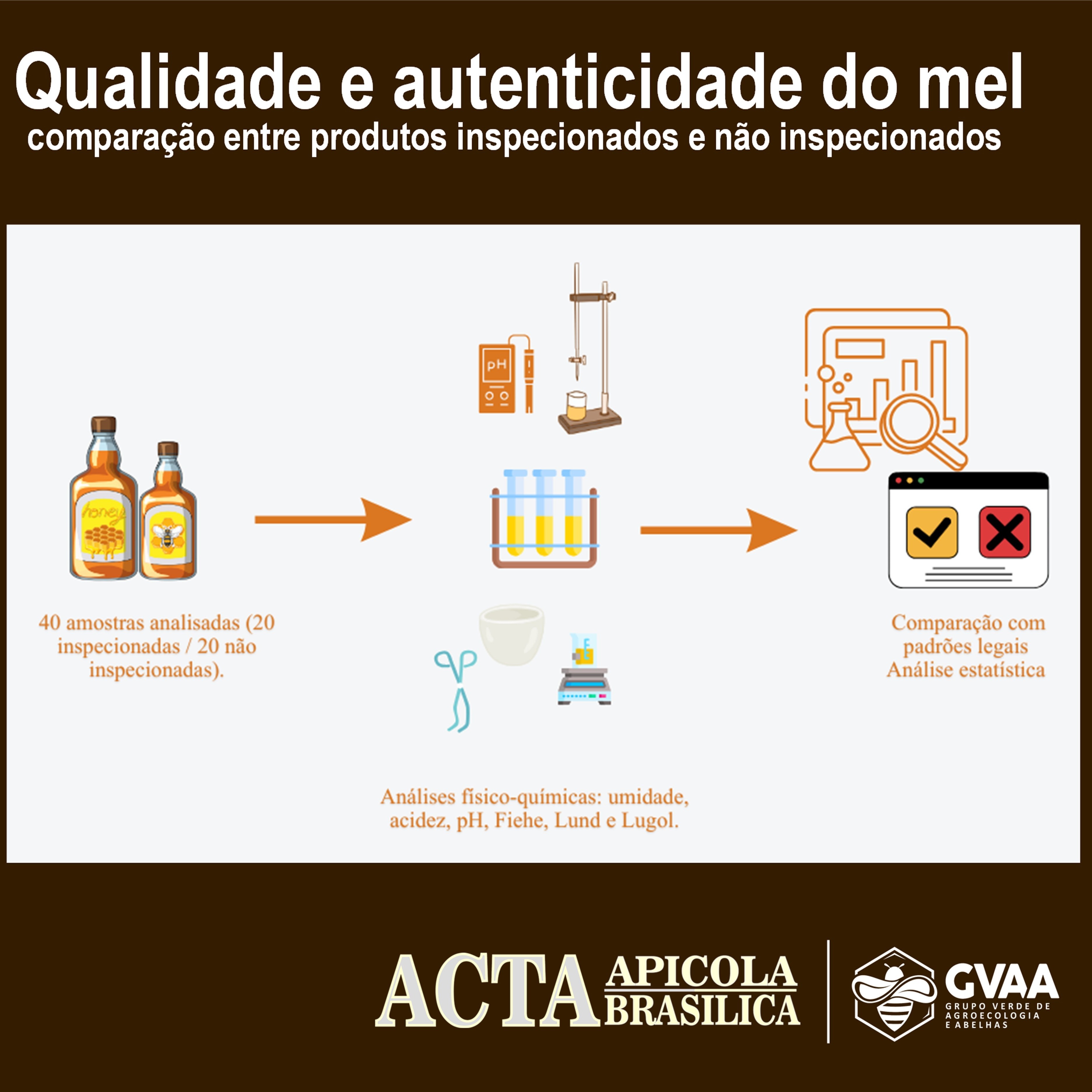
Brazilian legislation establishes strict physicochemical standards for honey produced and marketed in the country. Based on this, this study aimed to evaluate both inspected and uninspected honeys sold in Juiz de Fora, Minas Gerais, to detect adulteration occurrences. The physicochemical analyses performed included moisture content, acidity, pH, and the Fiehe, Lund, and Lugol tests. The obtained data were compared with legal standards and submitted to the Tukey test (p < 0.05). The results showed statistically significant differences between the two groups of honey. In the uninspected honey group, 65% of the samples presented some form of nonconformity, with 20% of these presenting multiple irregularities. In the inspected honey group, 5% showed nonconformity. Nonconformities were most frequent in the Fiehe test, suggesting the addition of sugar syrups. There was a correlation between the results of the Lund and Lugol tests, suggesting the presence of foreign substances in the honeys. The variations in acidity and pH of the uninspected honeys may indicate the addition of substances that intensify fermentation, reducing pH and increasing acidity, as well as failures in quality control and improper handling of the food. Therefore, the inspected honeys showed higher compliance with legal standards, with a lower occurrence of adulteration practices.
Downloads
References
ABDI, G. G.; TOLA, Y. B.; KUYU, C. G. Assessment of physicochemical and microbiological characteristics of honey in southwest ethiopia: detection of adulteration through analytical simulation. Journal of Food Protection, v. 87, n. 1, p. e100194, 2024. DOI: https://doi.org/10.1016/j.jfp.2023.100194
ANANIAS, K. B.; MELO, A. A. M. de.; MOURA, C. J. de. Analysis of moisture content, acidity and contamination by yeast and molds in Apis mellifera L. honey from central Brazil. Brazilian Journal of Microbiology, v. 44, n. 3, p. 679-683, 2013. DOI: https://doi.org/10.1590/S1517-83822013000300003
ARAÚJO, G. C.; MARIANI, M. A. P.; ZANETONI, J. P. F.; DUPAS, E. Mel do Pantanal e economia social e solidária: possibilidades a partir da análise de três realidades em Corumbá, MS. Interações, v. 24, n. 2, p. 651–666, 2023. DOI: https://doi.org/10.20435/inter.v24i2.3805
BRASIL. Ministério da Agricultura, Pecuária e Abastecimento. Instrução Normativa n. 11, de 20 de outubro de 2000. Aprova o Regulamento Técnico de Identidade e Qualidade do mel. Diário Oficial [da] República Federativa do Brasil: Brasília - DF, 23 out. 2000. Disponível em:https://www.gov.br/agricultura/pt-br/assuntos/defesa-agropecuaria/suasa/regulamentos-tecnicos-de-identidade-e-qualidade-de-produtos-de-origem-animal-1/IN11de2000.pdf. Acesso em: 22 jun. 2024.
CHETTOUM, A.; FEKMOUS, N.; BOUMENDJEL, M.; MEKHANCHA, D. E.; BOUDIDA, Y.; SEDARI, A.; BERREDJEM, A.; ATI, H.; ZAIDI, K.; BOUMENDJEL, A.; MESSARAH, M. Biological, physicochemical and antibacterial properties of pure honey harvested at the municipality of Seraïdi (Annaba, north east of Algeria). Food Science and Technology, v. 43, n. 3, p. e41022, 2023 DOI: https://doi.org/10.1590/fst.41022
DAMTO, T.; ZEWDU, A.; BIRHANU, T. Impact of different adulterants on honey quality properties and evaluating different analytical approaches for adulteration detection. Food Chemistry, v. 23, n. 1, p. e101524, 2024. DOI: https://doi.org/10.1016/j.jfp.2024.100241
DE BEER, T.; OTTO, M.; PRETORIUS, B.; SCHÖNFELDT, H. C. Monitoring the quality of honey: South African case study. Food Chemistry, v. 343, n. 1, p. 128527, 2021. DOI: https://doi.org/10.1016/j.foodchem.2020.128527
DODD, S.; KEVEI, Z.; KARIMI, Z.; PARMAR, B.; FRANKLIN, D.; KOIDIS, A.; ANASTASIADI, M. Detection of sugar syrup adulteration in UK honey using DNA barcoding. Food Control, v. 131, n. 1, p. 110772, 2024. DOI: https://doi.org/10.1016/j.foodcont.2024.110772
FINCO, F. D. B. A.; MOURA, L. L.; SILVA, I. G. Propriedades físicas e químicas do mel de Apis mellifera L. Ciência e Tecnologia de Alimentos, v. 30, n. 3, p. 706-712, 2010. DOI: https://doi.org/10.1590/S0101-20612010000300022
GALHARDO, D.; GARCIA, R. C.; SCHNEIDER, C. R.; BRAGA, G. C.; CHAMBÓ, E. D.; FRANÇA, D. L. B.; STROHER, S. M. Physicochemical, bioactive properties and antioxidant of Apis mellifera L. honey from western Paraná, Southern Brazil. Food Science and Technology, v. 41, n. 1, p. 247-253, 2021. DOI: https://doi.org/10.1590/fst.11720
GEBEYEHU, H. R.; JALATA, D. D. Physicochemical and mineral contents of honey from Fitche and Addis Ababa districts in Ethiopia. Food Chemistry Advances, v. 2, n. 1, p. e100177, 2023. DOI: https://doi.org/10.1016/j.focha.2022.100177
GOMES, V. V.; BANDEIRA, A. M. P.; CORDOVIL, K. P. S.; BANDEIRA FILHO, J. R.; BRAGHINI, F.; BILUCA, F. C.; GONZAGA, L. V.; FETT, R.; COSTA, K. S.; AZEVEDO, M. M. R.; TAUBE, P. S. Physicochemical characterization and antioxidant activity of honey samples of Apis mellifera and different species of Meliponinae subfamily from the Brazilian eastern Amazon region. Food Science and Technology, v. 42, n. 3, p. e114921, 2022. DOI: https://doi.org/10.1590/fst.114921
INSTITUTO ADOLFO LUTZ. Métodos físico-químicos para análise de alimentos. 4. ed. ZENEBON, O.; PASCUET, N. S.; TIGLEA, P. (coord.). São Paulo: Instituto Adolfo Lutz, 2008. (e-book).
LEBLANC, B. W.; EGGLESTON, G.; SAMMON, D.; KIMBALL, J. Formation of Hydroxymethylfurfural in Domestic High-Fructose Corn Syrup and Its Toxicity to the Honey Bee. Journal of Agricultural and Food Chemistry, v. 57, n. 16, p. 7369-7376, 2009. DOI: https://doi.org/10.1021/jf9014526. DOI: https://doi.org/10.1021/jf9014526
LUCA, L.; PAULIUC, D.; OROAIN, M. Honey microbiota, methods for determining the microbiological composition and the antimicrobial effect of honey – a review. Food Chemistry, v. 23, n. 1, p. e101524. 2024. DOI: https://doi.org/10.1016/j.fochx.2024.101524
MILEK, M.; BOCIAN, A.; KLECZYNSKA, E.; SOWA, P.; DZUGAN, M. The comparison of physicochemical parameters, antioxidant activity and proteins for the raw local polish honeys and imported honey blends. Molecules, v. 26, n. 9, p. e. 2423, 2021. DOI: https://doi.org/10.3390/molecules26092423
PENTOS, K.; ŁUCZYCKA, D. Dielectric properties of honey: the potential usability for quality assessment. European Food Research and Technology, v. 244, n. 1, p. 873–880, 2018. DOI: https://doi.org/10.1007/s00217-017-3011-2
RAWEH, H. S. A.; BADJAH HADJ AHMED, A. Y.; IQBAL, J.; ALQARNI, A. S. Impact of different storage regimes on the levels of physicochemical characteristics, especially free acidity in Talh (Acacia gerrardii Benth.) Honey. Molecules, v. 27, n. 18, p. e5959, 2022. DOI: https://doi.org/10.3390/molecules27185959
SAJID, M.; YAMIN, M.; ASAD, F.; YAQUB, S.; AHMAD, S.; MUBARIK, M. A. M. S.; AHMAD, B.; AHMAD, W.; QAMER, S. Comparative study of physio-chemical analysis of fresh and branded honeys from Pakistan. Saudi Journal of Biological Sciences, v. 27, n. 1, p. 173-176, 2020. DOI: https://doi.org/10.1016/j.sjbs.2019.06.014
SANTOS JÚNIOR, A. F.; BRANDÃO, G. C.; SANTOS JÚNIOR, M. C. S.; SANTOS, F. A. R.; MAGALHÃES, H. I. F.; KORN, M. G. Multi-element composition, physicochemical and pollen attributes of honeys from the Paraguaçu River (Bahia, Brazil) by inductively coupled plasma-optical emission spectrometry (ICP OES). Annals of the Brazilian Academy of Sciences, v. 92, n. 3, p. e20181196, 2020.. DOI: https://doi.org/10.1590/0001-3765202020181196
SCHVEZOV, N.; PUCCIARELLI, A. B.; VALDES, B.; DALLAGNOL, A. M. Characterization of yateí (Tetragonisca fiebrigi) honey and preservation treatments: dehumidification, pasteurization and refrigeration. Food Control, v. 111, p. 107080, 2020. DOI: https://doi.org/10.1016/j.foodcont.2019.107080
SILVA, G. S.; BERNARDONI, V.; SANTANA, R. M.; CALAÇA, P.; ASSIS, D. S.; LIMA, W. G.; GARDONI, L. C. P.; BRITO, J. C. M. Official labeled and unlabeled Brazilian honey. Comparison between physicochemical, microbiological, and microscopic parameters. La Revista Colombiana de Ciencias Químico Farmacéuticas, v. 50, n. 2, p. 457-475, 2021. DOI: https://doi.org/10.15446/rcciquifa.v50n2.97920
SMETANSKA, I.; ALHARTHI, S. S.; SELIM, K. A. Physicochemical, antioxidant capacity and color analysis of six honeys from different origin. Journal of King Saud University - Science, v. 33, n. 5, p. e101447, 2021. DOI: https://doi.org/10.1016/j.jksus.2021.101447
TESFAYE, O.; DESALEGN, A.; MULETA, D. Melissopalynological analysis and microbiological safety of fresh and market honey (Apis mellifera L. and Meliponula beccarii L.) from Western Oromia, Ethiopia. Heliyon, v. 10, n. 7, p. e28185, 2024. DOI: https://doi.org/10.1016/j.heliyon.2024.e28185. DOI: https://doi.org/10.1016/j.heliyon.2024.e28185
TIAN, L.; BILAMJIAN, S.; CUTHBERTSON, D.; ANUMOL, T.; LEOZ, L. JULIEN, C.; GIOVENAZZO, P.; CHAHAL, S.; BAYEN, S. Impact of processing steps (filtration, creaming and pasteurization) on the botanical classification of honey using LC-QTOF-MS. Food Research International, v. 194, n. 7, p. e. 114841, 2024. DOI: https://doi.org/10.1016/j.foodres.2024.114841
TIBOLA, C. S.; SILVA, S. A.; DOSSA, A. A.; PATRÍCIO, D. I. Economically motivated food fraud and adulteration in Brazil: incidents and alternatives to minimize occurrence. Journal of Food Science, v. 83, n. 8, p. 2028-2038, 2018. DOI: https://doi.org/10.1111/1750-3841.14279
TRIFKOVIĆ, J.; ANDRIĆ, F.; RISTIVOJEVIĆ, P.; GUZELMERIC, E.; YESILADA, E. Analytical methods in tracing honey authenticity. Journal of AOAC International, v. 100, n. 4, p. 827-839, 2017. DOI: https://doi.org/10.5740/jaoacint.17-0142
WU, J.; ZHAO, S.; CHEIN, X.; JIU, Y.; LIU, J.; GAO, J.; WANG, S. Physicochemical parameters, multi-elemental composition and antiradical activity of multifloral honeys from Apis cerana cerana in Hainan province, China. Food Science and Technology, v. 42, n. 7, p. e22522, 2022. DOI: https://doi.org/10.1590/fst.22522
Downloads
Published
How to Cite
Issue
Section
License
Copyright (c) 2025 Lara Beatriz Oliveira Mateus et al.

This work is licensed under a Creative Commons Attribution 4.0 International License.